Pop. Pop. ---
Originally Published in Quarterly West, Issue 103
The first thing the world lost was the ability to pronounce a specific, teeth-sucking emphasis occasionally used in one of the long dead languages of the central Eurasian steppe. But no one spoke that language anymore, nor cared to compare the events of the next three days with the notes of historical linguists, so it didn’t matter for a while. Most things are like that—small or far or so outside our ken that they might as well not have happened at all.
The gravel was different. We noticed it straight off. It looked the same, there in Lopez’s driveway—dusty and gray—but there was no feel to it. No grit, no scrape. Big rocks. Small rocks. Didn’t matter. Couldn’t feel them. None of them. Felt like we were standing on a cloud or something. Which was strange, sure, but less so once we noticed all that mist rolling in off the Pacific. It softened it up, maybe. That’s what Ducky said—must’ve been the moisture; must’ve been the elevation. So we kept on. It wouldn’t do for Lopez to see us there kicking and kicking at what felt like half-parts of nothing before we’d even really started. After all, we’d been hired to do a job.
Ms. Lopez was a hard-forged acquaintance of mine from a boozy back-corner booth at the Silversmith Lounge, and she’d offered Ducky and me a wad of dough for a winter’s worth of work. She had trees that needed felling before the winds caught them; branches to limb and stack; rounds to split. Ditches dug, scrubs cut, gutters swept, and something done about the woodshed roof, thing was a sieve. Lopez laughed when I poked at it and the water sluiced down onto my boots.
“Not much drying going on under this thing,” I said, and she laughed again, closed an eye, and tried to look through some hole to find where the leak was dripping through. But there wasn’t any specific gap. Wood was just all rotted through, shingles long gone. All the rain from October to May could soak through there free as hell, but no light nor wind could follow. A filter. More mossy skin than timber bone.
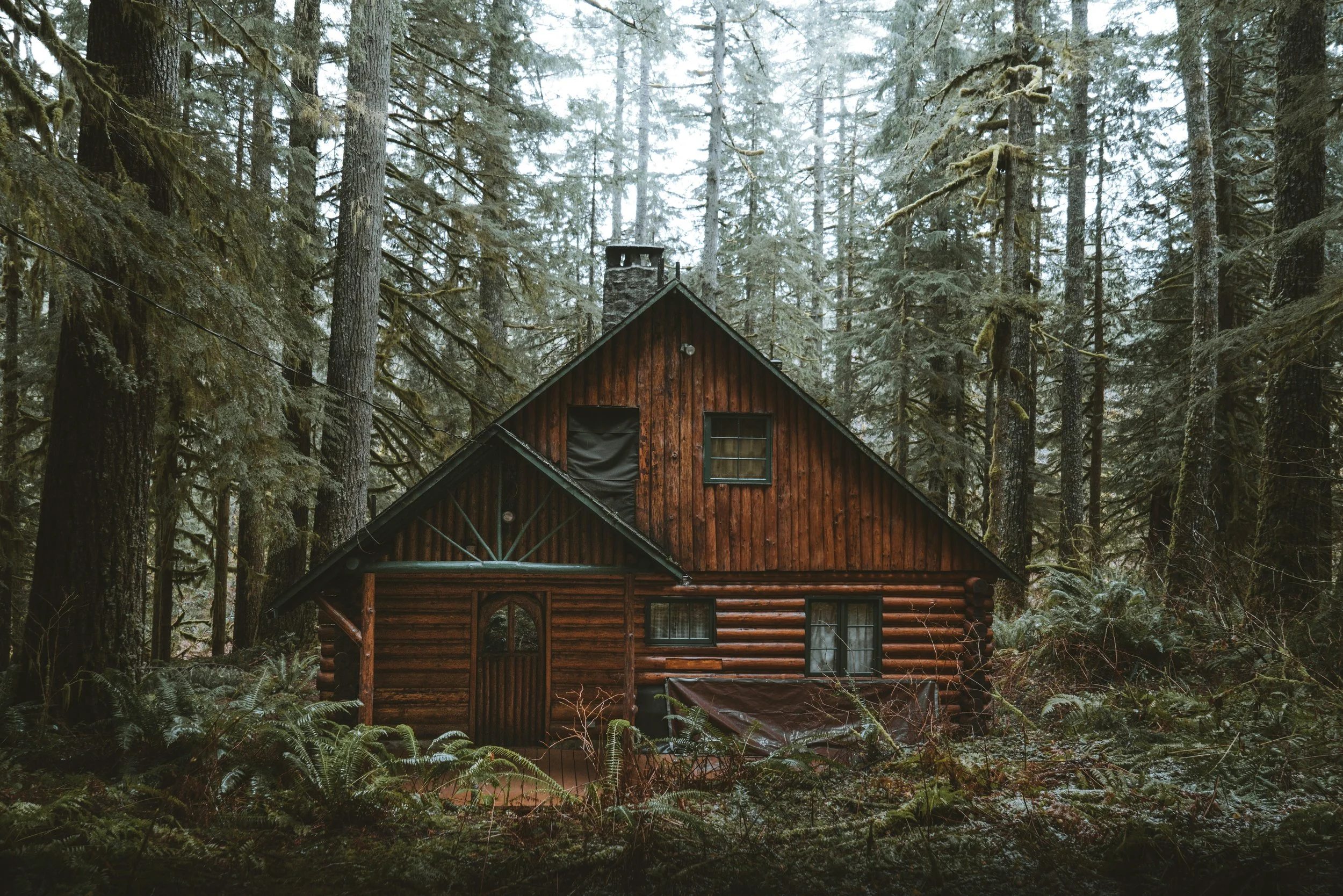
We walked the property after, tramping through the dew. Ducky laid it on as we went. I’d told him Lopez was wary of people she didn’t know; told him he needed to make an impression, so I hung back a bit and let him play the raconteur. The property was five acres, give or take, running uneven down the Chuckanut Mountains—chock-full of old cedars, pines, and fern-choked tangles, swaying in the gray-stoke air as it rolled in off the bay, land terraced and steep. Needles off the trees fluttering in the wind, not a one yet yellow; not a one yet swallowed by the muck.
Ducky talked and talked, laughed and smiled and half-finished stories, while Lopez moved a half-step ahead, nodding, and with one hand raised as if she were holding a candle. “Something’s coming,” she said after introducing us to her kitchen cupboards.
“Winter, miss?” Ducky offered.
“Nope,” she hiccupped, “Something else.”
And we three pondered that for a while.
She held things up as she showed them: gas canisters, sour cream tubs, window caulk, even the charred bits of mystery left over in the stove. Laying hands. Lingering. Mystic. Ducky liked all that. He got to following along in a way, reverence being a frequency that came naturally to him. He felt for the things beneath things too, but there was a hunger for it in his eyes. A hurry. A plan. That kind of thing made some folks nervous, but Lopez seemed to like it. Or maybe she was just in a hurry to get out and going and didn’t give much of a damn either way—maybe she had that slow, secret, buried kind of hurry that old folks got pulling down the corners of their eyes. Either way, she left not long after that. She said she had family down in Arizona; said they’d have her; said, too, that down there was as good a place as any to weather things, and we agreed, even though we didn’t know what was rattling away in her bones enough to get her going like that. Didn’t need to. We’d made out a good gig here. Hell of a lot better than my room under the bar downtown. Never seen a thing like it. Places above bars, sure, but below? Hours and hours of stomping and scraping and scooting raining down on through the cracks in the linoleum. No wind in the canopy, no green little needles twirling down. Ducky theorized it was some old prohibition deal, but speak-easy romance ain’t no kind of insulation, and liquor never seeped down through the floor. I had to get out much as I could.
So, there we stood, watching Lopez head out ‘cross a road of gray-gravel-nothing, off and away.
That night, the world lost:
The smell of goose shit.
Grasshoppers.
The sloppy feel of wet leather.
All the birds in Connecticut.
Thirty-two stars visible only from the Southern Hemisphere.
The feel of paper scraped between your thumb and forefinger.
And, around dawn, all the canned peaches. Peaches on the branch were going to be around until Thursday. That morning, it was just the canned ones.
We were up early the next day, our heads sour from celebrating. We took turns taking big, heaping gulps of water at the sink while the coffee percolated. Ducky was the strong one that morning, the one who’d nudged us up and towards routine. We had talked a lot about building routines beforehand. A hedge. A promise. You need routines when you’ve got so much space and time. Ducky and I were built for tight corridors; for have-to’s and oh-well’s; for jumping pad to pad and barely settling before we were off again to the next small, half-sinking place. If we dropped our routine, we reasoned, and got lost among the days or acres or bottles, we were sure to piss it all away. Besides, Ducky liked the word. Routine. It rolled off his tongue with the beat of a bat’s wings at twilight. You looked somewhere else, the horizon maybe, and there was Ducky flapping that word into the air. Routine. Hammering. Reaching. Clattering. Routine.
Finishing the coffee, I set out to start things off.
The loss of things was starting to pick up now, popping out all over the world. But we still didn’t know about any of that, and we’d already forgotten about the gravel. There was work to do. I swung the axe. I clattered the limbs. I grooved the saw. I felt the low crack of timber. I dragged the cedar piece by piece, piling and piling.
“Hey!” Ducky yelled.
“Hey!” I yelled back.
“You’re gonna wanna put that door back on before you do anything else!”
I crouched, nestled in the greenery. “What?”
“The door! The door! The door!” he hollered, swiping at the air with the flat of his palm, “Put it back!”
“The hell you talking about?”
“The door? The door?”
I shook my head. Shrugged.
“No?” He looked at me with his mouth screwed up and his gloved hands looking heavy at his sides. His quiet brought me over.
I understood when we reached the house. The front door was gone, the house wide open. We looked for intruders, calling out and waving tools in the cracked-open quiet of the place. But there was nothing. No one. It became strange. We searched but couldn’t find any trace of where the door might’ve gone. Its hinges were fine, and there were no splinters nor scorches nor broken remnants. It was as if the entire door had just wholly given way to absence.
Ducky mused for a bit. Quacking as he liked. He was curious that way—jumpy and prone to waddling off.
“Wind,” he eventually declared.
I looked downhill as a gust rose affronted.
“It’s blowing towards the house.”
“Yep. Right at the house.”
“No,” I said, “I mean, the door would’ve been blown inwards. Into the house. It would’ve snapped off and landed right there on the carpet.”
He pondered.
“It blew hard, which loosened some part or another, and then when things slackened up, it came loose and rolled down the hillside.”
We turned. The hillside didn’t slope to any kind of steepness for twenty yards or more. And there were no divots left from a tumbling corner or nothing. Still, we didn’t press it. Just stood for a while longer nodding at one another.
Some rain came in, silent in the boughs overhead.
“OK. Well… if it did go down the hill, it wouldn’t have stopped until it hit the water. If it did, it’s long gone by now—swept off, you know?”
“Yep,” I said.
We got some tarps from the garage, strung them up in the doorway, and got back to work.
Routine.
While we’d been talking, all the seeds of the world’s watermelons had disappeared. And the color orange and most kinds of beetles in South America and all of the rope in Hokkaido and boat propellers and any clock made before 1982.
By now, though, people were beginning to notice. By now, it was being talked about. By now, even if we didn’t know it, the whole world—in villas and colleges and churches—was wondering after their own disappearing doors.
We worked for a while longer. I was distracted. Uneasy. I figured Lopez would be upset, even though it hadn’t been our fault. But, then, there was all that laying of hands she’d been doing. She’d done it all over before she’d left. I couldn’t remember if she’d done it to the door. She’d of had to, I thought. Maybe she knew. Maybe she’d guessed. I cut. I broke. I worked. The house gaped at us with the wind sneaking down its throat.
We laid off the whiskey that night. Ducky started reading the news. It hadn’t been his plan. He just glanced at it, but the breadcrumbs were there waiting for him, and I’ve found that engrossment is incompatible with liquor. Not like those detective movies with the shadows and hard angles; the ones where the private-eye mulls and drinks in his office. No, Ducky couldn’t do that, and there was no revolver to finger on the desk, so we stuck to beer.
I sat. Ducky talked.
“Shit’s missing,” he said crustily.
“What? More doors?”
“I guess. That kind of stuff.”
I blinked. “Wait, what?”
“Just stuff. Things. There for a bit while people look and then they’re not. Here. Gone. People are talking about it.”
“What’re they saying?”
“That it’s odd, mostly.”
“It is odd.”
“Yep.”
He read on. I ran my finger over the aluminum of the beer can. It felt strange, come to think of it. Light. Empty. I wondered if I’d of just downed the whole thing without noticing. While Ducky followed the endless trail in his hands, I held the can up to the light. It had to be almost full, barely drank, but it was weightless anyway. I jostled it and felt nothing. I tipped it little by little and kept on tipping until a bit of beer splashed onto the table.
“Hell you doing?” Ducky asked out the side of his mouth.
“It felt empty. I was checking.”
“There’s a better way to do that,” he said, taking a swig and setting down his phone, “Weird shit’s going on out there.”
“Oh yah?”
“Yep. Stuff’s disappearing.”
“What kinds of stuff?”
“All kinds, I guess. Nothing in particular. Random, really.”
“Where?”
“All over.”
“Huh. Why?”
He shrugged, “Who knows?”
“Not me.”
“Me neither.”
“It’s odd, though.”
“That’s for sure.”
“Yes, sir.”
We cracked a couple more, and though Ducky pretended not to notice, I saw him sloshing at the weightlessness of his can before the air cooled, the Pacific climbed into the trees, and the tarp snapped restless well into dawn.
More. Gone. Toothpaste. Cold shudders. The wings of yellow jackets. Bathroom light-switches. The thin rainbow gasoline vapor makes in the sun. The feel of marbles on skin. The smell of lavender. Granite in Scotland. Any piping between 3 inches and 8 inches in diameter. The sound of hoof beats on a city street. Algae.
Faster and faster things were going. Like flashes of lightning until, around 2 AM, lightning went too.
Again. Up. Sour. Coffee, gulps of water, and a trudge out into the wet morning. Full rain now, wind too. The ocean, gale-green there through the gaps in the trees with its eye kept on us—too closely if you ask me. The air carried its voice and the smell of its rhythm. I tried to ignore it. I cracked fresh wood against those sensations, sent them reeling with the smell of cedar. I moved quicker than yesterday. I poured over the hill as I could. The gloves were useless along the slippery wet hickory handled tools, so I took them off and felt the suctioned, warm mixture of sweat and rain on my bare hands.
I saw Ducky in flashes. He flitted around the house like a hummingbird. Moving. Checking. Prodding. Peering. Doing everything to no clear purpose. He stepped quickly. Hurried and stopped. Like a horse going downhill—all jerks and bursts and reckless hurry.
It was contagious. Spreading to the scrub maples and the crowding ferns. Moving like a curse; like a silver, shimmering streak of adrenaline. I kept looking back at the house and back at Ducky, trying to see what he saw through the angle of his head or the arch of his back. Maybe more had gone wrong. But I didn’t care about some far corner of the world and the long list of things I would never see anyway. I care about here. I care about now. We hadn’t been paid up front. If Lopez came back to a ramshackle there’d be no money for either of us. That was here. That was now. That was real.
I walked down the trail and caught him back by the wood pile. He was standing still for a change and looking up at the roof of the lean-to. He prodded it with his finger and a whole section, big as his fist, tore up like a scab.
“Fuck you doing?”
“No moss,” he replied.
“What?”
“There was moss all over this yesterday. All on top. Like a blanket. And now, I don’t see any. It’s just gone.”
“Wind, Ducky. The wind took it.”
“There’s none anywhere. No moss, I mean. Not on any part of the roof, or the grass, or any of the logs lying around. None of it. There was tons before.”
“Wind,” I said again.
“Wind’s been doing an awful lot, don’t you think? First the door, now the moss.”
“You’re the one who thought it was wind in the first place.”
He nodded, poking up again. The flap he’d loosened hung down and the nothing poured on through.
At lunch, Ducky went back to his phone. He sat quiet at the table. Didn’t give me anything. Just read and read. I had to ask him eventually. Had to get something out of him.
“Craziest thing,” he said not looking up, “It just keeps happening. Things keep disappearing. Little stuff, big stuff. It’s like some practical joke, but the whole world.”
“What kind of stuff?” I asked again.
He listed some. Showed some pictures this time. Electric lines laying on the street because the towers had gone. Wheat fields drained of color. A frog without eyes. It was hard to think about and see that way. Because of the pictures now, it just seemed like these things had always been gone if you looked at the picture long enough. Seeing made it normal somehow. Ducky said that was stupid.
“And then there’s other things that are gone too,” he continued, “like, not thing things, but… I don’t know, things you know?”
“Things?”
“Smells,” he said quietly, “Smells. Or tastes. Or you know… things! How else would you say that?”
“I don’t know! I ain’t been reading it!”
He fell back in his chair. We listened to the weather. We felt the cold changing of pressure. We ran our hands over the glazed table. The quiet between us had so many sides, and on some instinct we made a point to look and to feel each of them.
It took some doing, but I got him up and working again. I retook the ridge. I picked up the axe I had nestled under some thick ferns. I felt the weight of it, which was expected, and that momentum carried me forward for a bit. Then, swing by swing, I started thinking about it. I started thinking about that feel, that warmth, that grip, that slick, catching feeling which burned between the strokes.
None of it was there.
I stopped. I pushed my thumbnail hard against the graining of what I knew was treated hickory and felt nothing. My nail glided over it as if it were glass, but without feeling. An empty, sensationless, hollow thing. I tried not to think about it at first. But it nagged at me. I knew what it was supposed to feel like and that switch, that hollow socket of a memory started to fill up, instead, with thought after thought after thought. I needed to shake myself loose.
I threw down the axe and went to find Ducky. He was standing on a hillside draw backed up on the far-side of the house. He was looking off towards the bay.
“Ducky! Hey, Ducky! The hell is going on out here? I’m noticing all kinds of weird shit, man. I don’t know if you’ve read any more but you gotta tell me what’s going on.”
“Ocean’s gone,” he said.
I felt my stomach drop, and was grateful for the feeling, for the tangibility. There, at least, was something.
“What do you mean?” my words sounded slow.
He didn’t answer. Just shook his head.
I turned.
Through the moving trees, I looked to the place beyond—what had once been water and waves and froth was now just distance. An empty, stretching horizon. Some kind of somethinglessness stripped of color and movement and smell and body. Paste, maybe. Dirty, shapeless paste.
Lots went with the ocean. Not only things in it, or on it, or near it, but things far from it. Things on mountains, sounds in valleys, colors in jungles.
There and then not.
Gone. Gone. Gone.
Pop. Pop. Pop.
Well, not ‘pop’ exactly. Because that’s still something; it’s a sound or a click of air or symbols written down, a hitch to tie the eye. It has heft, even if in the order of things that heft is small. But holes were punching through all over the hierarchy of notice, so even pop could be looked upon, as a thing itself, inadequate as it was to describe a halting of something else.
Pop. Pop. Pop.
From the inside, things don’t end. From the inside of the popping, there-and-then-notness of a thing, there is no definition or comment or reframing. There is only vacuum. Memory-less oblivion. No claim. Things do not end from the inside. They barely even pop.
Until they don’t even do that.
Pop. Pop. Pop.
Ducky and I tore through the tarp and into the house. He took up his phone and it would be a long while before he could be wrestled free, so I went through the house. I put my hand on things as Lopez had, looking for the sensations I remembered. Mostly, they weren’t there—more slick, filmy nothingness. I kept thinking what things would have felt like to Lopez; what should have been, willing it to be there now; holding, in my mind, what it was to feel wood or lacquer or cloth or plaster. Whenever I found something right, I brought it over to Ducky for a test, but by the time he ran his own hand over the plate or flashlights, pillow or candle the feeling was. Gone. Not replaced. Not changed into some new thing—just empty. Absent like the door.
I was inspecting the underside of the table when, as I stood, I saw that all of the glass in the windows had gone. But the bedside desks, the couch legs, the rolled up wrapping paper in a wicker basket, and the electrical sockets had gone without my noticing.
Ducky looked up. His phone, now without its glass, had been drained of life. A hunk of plastic and wires was all that remained—for now, anyway.
“No rain,” he said.
I looked out the window. He was right, “Yep.”
“The ocean—the whole ocean. Just… just gone. You saw it, right?”
I didn’t answer. I’d noticed the lack of colors by then. Like paint washed clean. More firehose than faucet. It happened right in front of us, like a blink; first lush green needles, bright and falling all around, drained in an instant.
And there was more besides. Lots more.
Gaps pierced everywhere in the landscape of sight and smell and touch and feeling and everything. Sluicing out. Moving off.
“-at should -e do?” Ducky said puckering his face stumbling over the –ords.
“-hat?” I said. And I felt it too. I’d tried for that sound. That “–” sound. It didn’t come. -ouldn’t. No matter ho- hard I tried. Ducky and I stood there, making faces at one another, trying to coax the sound out.
More. All of it. Not just the bones of the –orld, but the tissue, the sine-, the speckled drops of blood rolling together in its thousands to make liquid. Fast. Gone. Fast. Out. Faster.
And then the cedars -ent. Flash. The gray clouds s-am do-n at us like sharks after their prey. But there -eren’t sharks anymore. Only clouds in masquerade.
Ducky ran back. I –atched him go into the house. I sa- him through the lidless eyes of the -indo-s. He made noise. Lots of it. Instinctive. Barks and ho-ls and crash after crash until that too dropped a-ay. He hammered on the countertop. Hammered and hammered and hammered. He beat at the mystery. -ailed on it. He couldn’t chase it like before, couldn’t get a handle or a scrap of something to mull over. So he had to go hard at it another -ay.
I hurried up the ridge. Kicked through the tangle of drained and empty things. I -atched the light blue of the sky kick off. The clouds melted and dropped to nothing as they -ent.
I cast around for my tools, picking up the axe, its head -eightless in my hand. I stared at it. Lifted it up and do-n. It -as like I held nothing, like my fingers touched nothing, like my arm lifted nothing. By chance, corner of my eye, I sa- that the house had collapsed and realized the -hole thing had gone down -ith Ducky inside. Roof and beams and –alls –ere all folded do-n. No scre-s. That -as my guess. Ducky had to be dead. Or hurt. Or unconscious. But I didn’t feel any of the heft in those –ords, they’d been clipped free from any connection. -hat was the difference no- any-ay? He –as just gone, one -ay or another. Just a pop. There. Gone. Instantaneous. I continued non-lift lifting my axe. I felt its change, its end, and I –aited for my o-n bones to crumble.
But things don’t end from the inside.
Over and ov-r. Again. Focus. That -as l-ft. Som- scanning light.
Pop. Pop. Pop.
I stumbl-d. Th- rub-r of my boots -as gon-. My shirt had no color. I ripp-d it a-ay. Couldn’t hav- it on m-. It –asn’t cold any-ay. Couldn’t b- anymor-.
Gon-. Gon-. Gon-.
Dripping out and quick.
Th- m-tal of th- ax- --nt too.
It –nt, and no lightn-ss r-plac-d it. Just gon-. –ach thing, small and conn-ct-d and holding hands pok-d through by a pin. But no light sho-n through. Nothing backlit th- diorama.
Lik- fir-crack-rs, b-ing blo-n into nothing on- chang- at a tim-.
F—lings drain-d off. Surpris- had b—n follo--d by f-ar, rag-, -xcit-m-nt, and th- -hol- long sl— of oth-rs.
Drip. Out.
Drip. Out.
Dr-p. Ou-.
Dr-p. Ou-.
-h- sharks -n th- sky surfac-d out of s-gh-. No-h-ng up th-r- no-.
-r-p. Ou-.
Gon-.
-r--. ---.
G---.
Pop. Pop. ---.