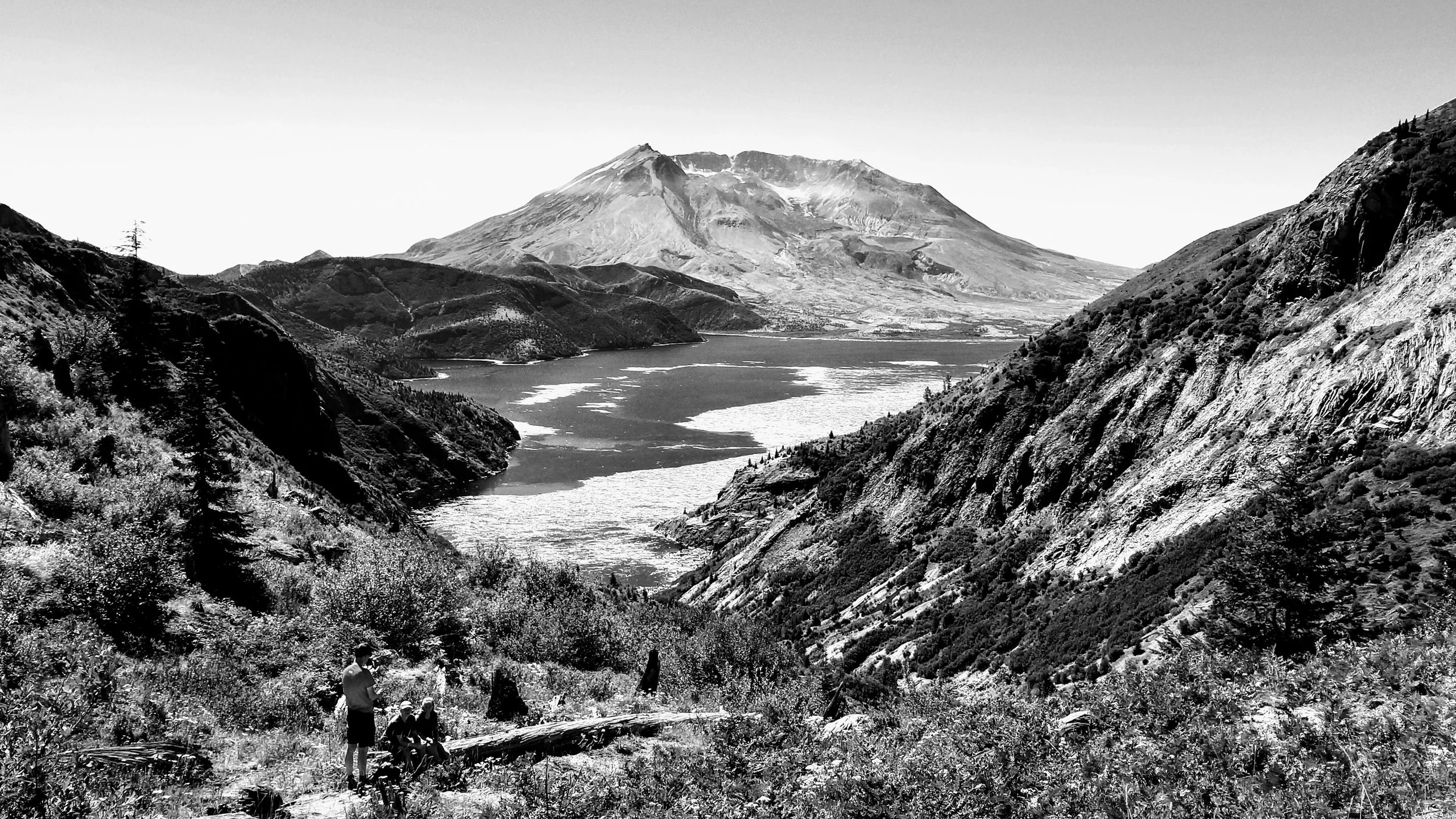
A Centennial History of Cascade Depths National Park
Originally Published in The Southern Review, Autumn 2022
May 18th, 1921 --- Mt. St. Helens erupts.
Mt. St. Helens—nestled into the high hills of the Cascade Mountain Range between Seattle and Portland—erupted with unprecedented force on the morning of May 18th, 1921. Two hundred square miles of forest was leveled in an instant, and the mountain’s entire upper section blown away. After, the ash fell for days over much of the United States and beyond, reaching as far as Iceland and the Philippines. Eighteen people were killed, with most never being recovered from within the blast zone.
“We had stopped overnight in the town of Castle Rock. It was morning, and we were readying to keep on, when the ground began to shake. Some fella or another started hollering ‘earthquake!’ so we got ourselves away from the buildings. People were scrambling all around and hustling so much that we didn’t notice the sky at first. A great cloud of ash was rising high over the eastern hills, off towards (Mt. St. Helens). Then we knew she’d blown. It was another panic, and hell if me and the boys didn’t high-tail it out of there. Before we’d reached Longview the ash started falling around us. It was like a black blizzard, and we had to stop. Off distant, we could hear bigger bits raining down and crashing through the trees. The ash burned our eyes and our throats. We abandoned the rig and walked the rest of the way with our shirts tied best we could around our heads. The ash just kept on coming.”
-Letter of from Saul Amberg, local timber company driver, May 1921.
Late Spring and Early Summer, 1921 --- The Cataclysm is recorded
There was immediate national interest in the disaster. Newspapers up and down the West Coast dispatched correspondents. Within weeks, charred artifacts—a few authentic but most fakes—were fetching astronomical prices in eastern markets as volcano fever swept the country.
“Nowhere outside of the Spanish Sahara or the Gobi is so totally devoid of life. It is destruction on a biblical scale.”
-The Olympia Times, article, June 1921
“I went searching/
Oh searching, oh searching/
All up the Missisip’ and down.
But she’d gone/
Oh she’d gone, oh gone/
My darlin’ Helen, gone like a cloud.”
-Vaudeville song, Jackson, Mississippi, July 1921
August 1921 --- The Depths Uncovered
Some three months after the eruption, married couple Lloyd and Winneth Truman set out for the mountain. They had hoped to take some pictures to sell to the newspapers, but instead they stumble upon a discovery of far greater interest than a few mounds of ash and some vaporized evergreens. Indeed, what they find on their expedition will change not only their lives but the lives of countless people for generations.
“NEW AGE OF DISCOVERY. INTREPID AND WIFE DISCOVER MASSIVE CAVE SYSTEM AMID BLAST ZONE.”
-The Portland Telegram, article, September 1921
“(In Portland) most other men—when they saw the towering cloud of destruction rising from the north—went first to fear; I went first to my pack horse. I thought only of discovery. I thought only of what might be discovered in so transformed a place. Thus, steeled for every danger yet confident in my abilities, did I go forth.”
-Lloyd Truman, Remarks to the Subterranean Brotherhood of Discovery (SBD), Longview Lodge, May 1928
“(After several days traveling through the blast zone) Lloyd and I came upon a sharp decline between two hills. The ground looked pushed up and recently disturbed. It struck me as curious, so we descended to investigate… (after their descent) … Things felt strange immediately. In those blasted lands near the mountain, it was no great rarity to encounter silence, but there, so tucked into the breast of the earth, the silence became almost primordial. Easy to say now perhaps, knowing what we were to find there, but I would swear to you that it was as if pure nothingness was bubbling up from below.
Lloyd wanted to turn back. He feared the gasses or some earthen collapse which might swallow us and the horses. His concerns could only be assuaged by agreeing to tie off our mounts and proceed on foot. This was a reasonable precaution…
We did not travel long under our own power before we saw it: the entrance to a massive cave. It was forty-five feet across and twenty-feet high, turned on its axis slightly upward, as if it were the gargantuan mouth-breach of some stony leviathan. It breathed as one too. Air spilled out from some deep, deep lungs and pushed warm against our faces, even while we were standing as far as a hundred feet distant.
Lloyd was terrified and could not be mustered a step closer, so I investigated alone. The cave mouth itself did not look recently formed, for it appeared worn smooth in many spots, riven with streaks of black-glass basalt. In other sections the rock was like a kind of pumice and felt very spongy. Not far in, but out of direct sunlight, there were a number of wondrous plants; sinewy, long and black. Their eight-foot-long fronds glimmered in the refracted light. I could see that they continued far off into the cave. Down in a similar direction stretched countless natural paths. From where I stood, I heard the choral skittering of the cave’s strange, multitudinous lizards. I did not want to venture too far among them, seeing as how it seemed easy to become quickly disoriented.
I returned to Lloyd, coaxed him into joining me, and together we went to exhaust the few camera slates we still had yet unused.”
-Winneth Truman née McCowan, from her memoir: All is Revealed, first published 1962.
Winter of 1921 – Early Spring of 1922 --- The Robertson Descent
The newspapers kicked up a frenzy. With his pictures and tales of adventure, Lloyd Truman was an immediate media darling while Winneth was largely sidelined. Within weeks a number of expeditions were planned to replicate their journey. These early trips were disorganized, ill-equipped affairs, teamed by well-to-do neophytes. Most reached the caves only to take cursory sketches, notes, and photographs, but didn’t descend beyond the cave entrance’s rim of sunlight. They achieved little for the scientific understanding of the cave, but did build momentum for a future, much better equipped venture into the dark place. By the following year, that momentum—and the resulting newspaper fixation—caught the attention of the renowned spelunker Autlif Robertson. In early March, Robertson assembled his team for an ambitious expedition.
It would be his last.
“I have heard very little in regard to the cave save for its size. Size is a small thing. I am far more familiar with the tight spaces under the earth than the large, but I do not fear the difference. We will go. We will reach the bottom. It is a simple thing.”
-Autlif Robertson, letter to his brother, February 1921.
“I had woken up that morning, the ninth morning, with a terrible headache and an inability to stand fully upright. We had all been suffering from some taint in the canned foods, but I was particularly laid low. A day before, Charles had gone unconscious and we feared greatly for his health. Over the preceding 36 hours, the team had become mightily disoriented. (Robertson’s) fury had quieted over the bad luck of the last two days into something of a fearsome pout. He was scornful of our suggestions and lashed out at every mention of the world above, deeming such words as marks of cowardice. This brought among the men a terrible silence. These were men of experience; possessors of knowledge that could have changed the course of things perhaps, but most were too terribly afraid of (Robertson) and his indictments to speak their minds. This was the cause of our worsening predicament.
It must be said, by that juncture we’d become hopelessly lost. The cave was a thicket of crossing rises and valleys, tight passages and massive, almost open-air spaces whose edges tumbled down into the inestimable dark. It was like nothing any of us had ever seen, and in the chain of markings we laid behind ourselves to track our return, things had gotten disconnected and confused. We could not reckon our path back to the surface. Lost.
Because of my condition, (Robertson) commanded that I stay behind with Charles while the rest of the team reestablished themselves. This was no act of kindness; all among us knew it to be the sentencing of death. Not a man protested. Through their silence, my fellows passed their judgement upon me. Few could look me in the eye, nor could they utter poor Charles’ name without a catch in the throat.
They departed.
My own timepiece had been damaged in a fall, but that around Charles’ limp wrist told me that we lay in that spot for nearly forty-eight hours, alone, mostly in the dark. In time, my strength returned enough for me to walk. Only a fool would move his position in such a place without alerting his team; only a fool. I was that fool. I could not bear it, and I had no team left.
That damnable dark.
I have no doubt that Providence pitied me and my foolishness, for it was only through God’s guidance that I managed to stumble upon the lost connection which led me back to the surface.
Charles’ body was found a month later. The rest, never.
I am ashamed.
-Edmund Longmire, inquest, August 1922.
“ROBERTSON AND FIVE OTHERS PRESUMED LOST! LONE SURVIVOR RECOUNTS GRIM TRAGEDY OF THE ST. HELENS CAVE”
-Times of London, front page, April 10th, 1922
Summer, 1922 --- Intervention
The doom of Autlif Robertson seized the imagination. He was toasted in the same breath as his fallen predecessor Sir. Robert F. Scott, and ‘the St. Helens Cave’ (as Cascade Depths National Park was called then) became a terrible obstacle viewed as formidably as the Antarctic or the Himalayas. People flocked to the place. Local government was immediately outmatched by the crush of fantasists, pilgrims, jaundiced adventurers, and fraudsters of all kinds.
“BE IT RESOLVED – that COWLITZ COUNTY forms, as a law enforcement body of the county and its wildlands, THE COWLITZ COUNTY UNDERGROUND RANGERS, who will have the first policing authority over all places subterranean within COWLITZ COUNTY.
“BE IT RESOLVED – that COWLITZ COUNTY restricts and restrains any and all exploration of the ‘St. Helens Cave’ without license obtained from THE COWLITZ COUNTY UNDERGROUND RANGERS. Any person detained with intention to descend into said cave or otherwise defy the orders and authority of these rangers, will be placed in prison for no more than 10 years, and/or will obtain a fine of no more than $2,500.”
-Cowlitz County Ordinance, September 1922.
“There is no tavern man anywhere along the northward bend of the Columbia River who will not proudly state that he, or he along with a bosom friend, has reached the deep dark of the St. Helens Cave. If I took every one of these claims as truthful and purview to my authority, I’d have the county emptied in a fortnight.”
-Madris O’Driscoll, Cowlitz County Underground Ranger (CCUR), February 1923.
“The evening before last, word reached Castle Rock that a large meeting of revivalists, some twenty miles from the St. Helens Cave, was broken up by the rangers on charges of ‘incitement to descend.’ Contraband found within an earthen storeroom was seized on account of its being subterranean and jurisdictionally available to the rangers. Lawyers obtained in Longview in defense of the revivalists deem the ranger actions to be of dubious legal merit.”
-The Portland Telegram, article, January 14th, 1924
“Know how to bribe a ranger? Same way ya bribe anybody else, only cheaper.”
-Cowlitz County joke, November 1926
Spring, 1925 --- The Easterman Expedition
The creation of the CCUR and increased governmental attention drastically restricted any large or organized trip into the cave beyond the initial entrance complex. At this time, the cave was still difficult to reach, requiring a week or more of arduous overland travel from the nearest roadway. However, everyone knew it was only a matter of time before the next high-profile expedition would need to be allowed. The country was rabid for it. Eventually, the CCUR petitioned the business community to contract the best spelunker they could find, and after some searching, the man they found was J.J. Easterman.
“Easterman is assembling an eminently capable team of first-rate climbers, navigators, and men of science. The man himself seems a strange leader, bearing nothing of the soldier’s countenance his Belleau Wood record would reflect; he is small of stature, learned, and all but incapable of raising his voice. Nevertheless, the city is behind him. Bon voyage, Mr. Easterman!”
-The Portland Telegram, April 1925
“I have spent my life in caves. Mammoth Cave. Meramec. Kartchner. Carlsbad. But never have I seen anything like these Cascadian Depths.
It is not a cave. It is a subterranean mountain range.
There is a wonder to it that cannot be properly expressed in words, nor even obtainable by sight. For truly reckoning with the space is a task for which our minds are greatly unaccustomed. The space gnaws at the back of one’s mind. With our lanterns and our lights, we could pierce the darkness to see the gargantuan stalagmites and stalactites, the soup ladle shaped slides of smooth rock; we could make out the far distant glittering of magma popping to the surface for mere seconds across divides many miles long; we could smell the strange mix of Paleolithic odors frozen in the never-before disturbed air; we could walk as if we were the first men in existence among the naïve, trusting creatures and the statesmanlike flora of the untouched kingdom, each piece of the journey more incredible than the last, but taken together, and as a whole thing, all these impressions more truly marked the soul than any landscape I have thus seen.
I know it must have a bottom, same as the heavens themselves must have limit, but it seems the edges of both are meant to remain beyond man’s grasp and beyond even, perhaps, his imaginings.”
-Introduction to The Cascadian Depths: An Accounting of Our Journey into the St. Helens Cave by J.J. Easterman, January 1926.
“EASTERMAN TRIUMPHANT! LOWEST KNOWN POINT REACHED YET IN THESE ‘CASCADIAN DEPTHS’”
-New York Times, front page, June 21st, 1925
“James Joshua Easterman has entered the pantheon of adventuring men. His christening of the cave’s deepest point, the newly named ‘Truman’s Nadir’ is… (several rounds of cheers) … is a testament to all that can be achieved by mankind, upon, above, or below this earth!”
-Toast at the celebratory dinner of the Subterranean Brotherhood of Discovery (SBD), Truman, McCowan, and the Easterman team in attendance, September 1925
1925 – 1936 --- Cascadian Depths National Park
Our modern conception of the Cascadian Depths National Park, in many ways, begins with Easterman. Many of his names for places, paths, and sights have stood the test of time even a century later, a few famous sites notwithstanding. Indeed, his phrase, ‘Cascadian Depths’ quickly became the de facto name for the cave system. The name changed public perception. Easterman may have encountered the incomprehensible void, but by putting words to the buried wonders he saw, he brought the space that much closer to the bank manager in Portland, or the weekend climber in Boise, or even the idleness-ravaged peer of the distant Sussex countryside.
Easterman, in other words, was the last true explorer of the place. Next came the tourists. Next came the national park.
“New world wonder! Book your voyage today! Tokyo – Seattle – St. Helens.”
-Travel ad from Osaka, Japan, translated from the original Japanese, March, 1929.
“Cowlitz County Highway Improvements --- $1,200,000
Entrance Complex Visitor’s Center --- $400,000
Castle Rock Downtown Improvement Fund --- $250,000
Cowlitz County Underground Rangers Operations --- $120,000
Utility Expansions --- $50,000
Public Interest Campaign --- $21,000”
-State of Washington budget, “Cascade Depths Growth Plan,” June 1927
“What has happened to the cold, open, deep (Cascade Depths) we once knew? Where there was once soothing darkness there are now garish, bordello lights. Refuse rises past the boot and is discarded over every inch of ground; sublimely formed stones have been chipped at, broken, and pillaged with abandon. Many of the great plants within reach or upon the cave floor have been ravaged. You cannot walk a foot without being accosted by some fatuous charlatan who would guide you downward only a yard or two before demanding extra payment for an entirely concocted hardship. Every wonder has now been made an enterprise for little, little men.”
-Winneth Truman née McCowan, editorial, The Portland Telegram, 1930
“Deluded, anti-progressional, and Bolshevik in the extreme.”
-Lloyd Truman, commenting on Winneth McCowan’s views shortly after their divorce, April 1932
“The recent economic panic on Wall Street is of little concern to the tourist trade here in our county.”
-Cowlitz County Commissioner, February 1930
“August 19th, 1931 --- No visitors.
August 20th, 1931 --- No visitors.
August 21st, 1931 --- Three visitors. One a vagrant.
August 22nd, 1931 --- No visitors. Two deputies suspended for on-duty drunkenness and inappropriate discharge of service revolvers while inside the hole.
August 23rd, 1931 --- No visitors.”
-Cascadian Depths Logbook, CCUR Capt. O’Driscoll, August 1931.
“Cowlitz County is in earnest and immediate need of government assistance. Our industries have collapsed. One out of every two persons in the county is unemployed…”
-Cowlitz County Commissioner, letter to state capitol, 1932.
“(The Civilian Conservation Corps) has gotten plenty of recruits for the work.... We get them from all over: Portland, Vancouver, Chehalis, Olympia, Seattle, even as far north as Bellingham. Long as there’s no work anywhere else, the boys keep on coming… It took a while to convince a number of them to head down into the caves, but we came up with a rotation, some men down below and some men out in the hills at regular intervals, and we upped the pay to $40 a month if at least two weeks are spent underground. After a while most changed their tune. (J.J. Easterman’s advisory commission with the Department of the Interior) has been a boon. With his help, accidents have been minimal. Morale remains high…
… Some of the boys take to the caving life more fitfully than others. A few simply couldn’t stand it and have been reassigned. My junior officer himself can’t get within more than a few yards under before he has some kind of severe attack, but he is a good logistics man, and I would prefer to keep him. Myself, I love it…
We’ve made good progress. By the start of next year, we will have dug out about 21 miles of serviceable trails, and surveyed for a further 15 or so… (We) put in signage, emergency call boxes, got railing up for almost the entire entrance complex. An auxiliary team is building out some of the access roads as well… You’ll hardly recognize the place when you come for inspection.
All’s swell.
…
Addendum – Three more mule teams would not go amiss.”
-Company Commander Wolczek, end of year report, Cascade Depths CCC station, December 1933.
“Be it enacted by the Senate and House of Representatives of the United States of America in Congress assembled, that the national forest land designated in the primary clause of this act, that which is known as the, the ‘St. Helens Cave Complex,’ the ‘Great St. Helens Blast Zone,’ the ‘North-face Volcanic Zone, Mt. St. Helens,’ and the ‘Cascade Depths Forestlands,’ is, by act of Congress, reformed into the Cascade Depths National Park, effective January 1st, 1936.
-Act to establish Cascade National Park, 74th Congress of the United States, September 1935.
1937 – 1970: Among the Giants
With official park status, Cascade Depths National Park took on an unmistakable gravity. People, growth, money, power; all poured into the region in uneven and contested ways. Castle Rock, Washington, the nearest town to the original eruption site, grew at an astonishing rate. Safety within the cave was improved; areas made off-limits without permits; and the surrounding timberland became thick with expensive chalets and rustic lodgings.
Cowlitz County became unrecognizable; surprisingly cosmopolitan and rapidly urbanizing. But these changes often came at the expense of those who had been living near the park area since far earlier than 1921.
“The court finds that the so named ‘Cowlitz Tribe of Indians’ in its filing against the Indian Claims Commission and the National Park Service is not due compensation nor allotment from the State of Washington, nor from the federal government in the case of Cowlitz v. National Park Service due to lack of federal recognition of tribal status. Secondarily, the court finds that such lands as Cascade Depths National Park cannot be so claimed in these standings as they are not appreciably connected to the land claimed above such underground sites. The case is dismissed with prejudice.”
-Ninth Circuit of Appeals ruling, Cowlitz v. National Park Service, August 1951
“…We never went near the mountain. We never talked about the ‘park.’ To the elders, all of that was to be avoided, and we needed to get ourselves away from it. It was this thing which was always expanding and dangerous. It was almost as if the mountain had never stopped erupting, except now it rained down roads and towers and tourists rather than ash; more and more every year.
My father fought through North Africa, France, and Germany with the second armored division during the war, but never once did he drive the 45 miles from our house to Cascade Depths National Park. In (the 1950’s) those roads were dangerous for any American Indian, but particularly so for those of us who were Cowlitz.”
-Jane Sahale, Cowlitz nation, from her memoir: Long Shadows, published 1985.
“PROSECUTOR: Are you aware of any prejudicial activities performed by any member of the rangers under your supervision?”
PARK SUPERINTENDENT O’DRISCOLL: I am not.
PROSECUTOR: So, you are unaware of any incidents involving them and their interactions with native Indians in the area?
O’DRISCOLL: I am aware of interactions, but, I, well, there were interactions where the, uh, rangers acted commensurate to their roles.
PROSECUTOR: And you would define attempted vehicular manslaughter as commensurate?
DEFENSE: Objection, your honor, the prosecutor is leading the witness disgracefully.
JUDGE PERNACKI: Sustained.
PROSECUTOR: Supervisor O’Driscoll, are you aware of the allegations against your deputy, one Jonathan Barnhill?
O’DRISCOLL: Yes.
PROSECUTOR: Then you are aware that Ranger Barnhill is accused of attempting to run a Cowlitz man by the name of John Beel and his family off of highway 504 on the night of October 16th last year?
O’DRISCOLL: I am aware that he was accused of that, yes.
(Interruption of indeterminate cause)
PROSECUTOR: And that, uh, Ranger Barnhill was on duty? You are aware of that aspect of the charge?
O’DRISCOLL: Yes.
PROSECUTOR: So then would you gauge it to be an appropriate response from one of your rangers, while in uniform, to try and force a car off the road with no warning nor sign that such action was about to be taken? Don’t you deem such action reckless in the extreme?
O’DRISCOLL: It would depend.
PROSECUTOR: On what?
O’DRISCOLL: Well, we are commissioned officers of the law, so, there, there are times when we have to intervene in situations much as any officer of the law would. Much like any police officer in Castle Rock or Portland would. That’s our role.
PROSECUTOR: And if no wrongdoing had triggered such action by an officer of yours? Would you deem dangerous interventions on the part of your rangers appropriate simply as a matter of course regardless of circumstance?
O’DRISCOLL: No. There would need to be cause. And I’m sure—
PROSECUTOR: —Superintendent O’Driscoll, in your own words then, would you say it is appropriate for any of your rangers to run a car off the road without warning or without clear demonstration of cause? Yes, or no, Superintendent O’Driscoll?
O’DRISCOLL: No. No I would not say that that would be appropriate behavior in that instance…”
-Cowlitz County Superior Court, Cascade Depths, National Park Service v. Beel, March 1957, case dismissed.
“If any place in this country can be said to be thriving it is Yosemite, it is Denali, it is Zion, it is Big Cypress, and it is Cascade Depths.”
-Margaret Murie, speech, May 1961
“I don’t get it. Seems like a big hole.”
-Edward Abbey, essay: Me and the Hole, National Geographic, September 1964
“And here you can see a great example of the Caverna Polypodiopsida, or what we call ‘St. Helens Night Fern.’ This is a particularly big—oh, careful, ya there you go—uh, particularly big specimen with its fronds extending, what would you say, Jean? Thirteen feet? Ya. Thirteen feet long. So that’s about as long as an Oldsmobile, give or take.
Now, what’s fascinating about the Night Fern is that it does not need direct sunlight. In fact, if it’s exposed to that much surface radiation it will die very quickly. Instead, it has adapted to gain energy from the indirect radiation of the magma exhausts within the park system.
And, OK, I’m gonna turn the lantern down for a few minutes and let’s see what happens… (a few minutes later) …OK, so you can already see—is your camera picking that up? Good. So you can see here that the middle of each of these fronds is beginning to glow faintly in the darkness. It’s a pretty neat affect, right? Sometimes it’s more pronounced than others, which we’re learning more about day after day. It’s something to do with inter-cave exhausts or, you might say, wind from within the ground, which supplies more or less radiated material that in turn stimulates the plants. It’s really quite beautiful, isn’t it?”
-Dr. Patrice Chu, PBS special: “Night Fern and Other Fantastic Flora of Cascade Depths National Park,” 1969.
“I wish that we could see the fruits of our labors before even we plant the tree. Perhaps then I would have chosen differently. But it is not so.
I visit the cave now—it will always be a cave to me, in all the simplicity and beauty that this word may conjure—and I see nothing but the hand of people … The cave no longer feels like a special place. The paths. The food-stands. The hourly walking tours. The little ranger caps and flashlights and endless, endless stomping of feet.
I wonder sometimes if we can be anything but scythe to nature. I wonder if that is why we must control and domesticate the wild spaces, for it is only that way that we can harvest them time and time again, and in so doing strip all of the wildness from life’s grains.
Yes. It can be said that I have regrets.”
-Winneth McCowan, conclusion, All is Revealed, 1962.
1970 – 1990 --- The Nadir
Even with a half-century of investment, Cascade Depths National Park could only modernize so far. The ten square miles of what was considered the ‘Entrance Complex’ had an increasing multitude of amenities and activities to engage visitors, but the entire park itself stretched for another 206 additional square miles of sharply declining development. Some of that portion had walkable trails and rudimentary safety improvements, but the vast majority of it stretched off into the darkness as if forgotten. At the far end of this veiled space, down some 7,242 feet below the cave entrance, was the lowest point—Truman’s Nadir.
“I, the undersigned, understand and agree to the following points as necessary preconditions in attainment of a full depths license and pass for Truman’s Nadir. CCUR code 17:
…That all visitors beyond the Cascade Depths Entrance Complex must have in their possession food to last for twice the estimated length of their journey, water of the same, fuel of the same, lighting of the same, and a CCUR approved emergency kit for each descending person.
That all visitors are subject to delay or cancellation based on other safety factors assessed by the CCUR, the National Park Service, or other relevant authorities.
That each visitor’s depths license pass must be produced on request.
That visitors might not be rescued if conditions are deemed unsafe to the CCUR or rescue party members.
That the path to Truman’s Nadir is inherently dangerous and must not be attempted without route and trip approval by CCUR or National Park Service, Castle Rock Station staff…”
-Full Depths Descent License sheet, form 3A, August 1971
“In 1971 there were four separate attempts to reach Truman’s Nadir. All but one was forced to turn back before reaching their goal. But the five-man crew headed by Samuel Melberg managed to reach the park’s lowest point and return on November 18th in the record time of ten days, fourteen hours, and sixteen minutes. Mr. Melberg described the experience as ‘The most intense week and a half of my life,’ upon resurfacing. The SBD congratulates the team on their record.”
-The Subterranean Brotherhood of Discovery, July 1972.
“A boot so reliable it can carry you from Rainier to Nadir and every trail in between!”
-Banner Boot advertisement, Seattle metro area, June 1974
“1971 – Team Malberg, new descent-return record: 254 hours and 26 minutes.
1972 – Team Malberg.
1973 – Team Jefferson and Ridley, new descent-return record: 242 hours and 53 minutes.
1974 – Team Jefferson and Ridley.
1975 – Team Jefferson and Ridley.
1975 – Team Jefferson and Ridley.
1976 – Team Rothschild, Courtney, Becker, new descent-return record: 209 hours and 1 minute.”
-Outside Magazine rankings, December 1976
“It’s really something to see the flags left behind at the bottom. I remember pretending to be Easterman when I was a kid, crawling under my family’s old barn floor. And then when you reach the Nadir, you see all those flags, right? It’s far out, you know? I kind of couldn’t believe it. And we had to turn around really quick to keep to our goal time; we only spent something like five minutes down there. Five minutes! But for weeks afterwards, that moment was all I could think about. I just couldn’t believe it. I’d stood at the lowest accessible point on earth. And being the first woman? I don’t know, I just couldn’t believe it for a long time. Still can’t (laughter).”
-Jenny Becker, ESPN interview, Trailblazers, November 1977.
“Cedric Arlee and Robert Littleman of Grand Mound, Washington are planning the first all American Indian expedition to Truman’s Nadir. The Cowlitz, Chehalis, and Nisqually tribes are represented within the group. When asked if Arlee and Littleman intended to contest the descent record, Arlee said, ‘No. We are not interested in that.’”
-The Olympia Times, May 12th, 1978
“STANDOFF AS NATIVE GROUP OCCUPIES PARK’S LOWEST POINT!”
-The Olympia Times, May 26th, 1978
“We, the peoples of the Confederated Chehalis and Cowlitz tribes are aware of no legal authority by which the US Government has laid claim to the underground area now known as Cascade Depths National Park. We claim this land as our own. We are prepared to enter into treaty negotiations with the US Government on how visitors may continue to peacefully use this land in accordance with their historic practices.
We, the peoples of the Confederated Chehalis and Cowlitz tribes claim the spot formerly known as ‘Truman’s Nadir’ and give the spot its true name of Point Ohanapecosh.
We, the peoples of the Confederated Chehalis and Cowlitz tribes, are the descendants of the rightful stewards and keepers of the lands of what is now southwestern Washington State. We demand federal recognition of the Cowlitz Tribe and other unrecognized tribes within the state. We demand the remediation of unmet treaty requirements, and the formation of new agreements which will curb the aggression of the US Government.”
-Point Ohanapecosh Declaration, signed American Indian Movement (AIM), Castle Rock, Cedric Arlee and Robert Littleman, May 25th, 1978.
“Until such time as order can be restored, Cascade Depths National Park is closed to visitors, effective immediately.”
-CCUR Commander Merlyn Warner, May 27th, 1978
“PAUL DUKE: There’s been a lot of questions about what your end game was at the time, about the purpose. Can you, well, can you speak to that?
CEDRIC ARLEE: The goal wasn’t to last down there indefinitely; the goal was to take the lessons AIM learned from (the occupation of Alcatraz) and apply them. We had a small group and we were disciplined. We’d trained. It wasn’t meant to be permanent; it was meant to be galvanizing.
DUKE: Galvanizing?
ARLEE: To the American Indian community, yes.
DUKE: There seems to be a lot of differing opinions on the standoff out there. Do you think you were successful?
ARLEE: Yes, I think we were. We’ve been fighting this battle for hundreds of years, and in the here and now things can feel less unified than we’d hoped, but we’re confident. We are. You have to be bold and the people will follow you.
DUKE: Well, a lot of those people have maybe been critical, too, of you and your group arming yourselves. How do you respond to that?
ARLEE: I’ll point out to you and your viewers that those arms were never used. Never taken out of their holsters, even. That seems to get ignored a lot in coverage. But the broader point has to be made that when you look at Wounded Knee, whether a hundred years ago or ten, it’s clear that members of the American Indian Movement have to be ready to meet the aggression of the government. The rangers didn’t show any restraint, did they? Violence isn’t what we wanted, not by a long shot, but anyone who looks at the history here will understand the necessity of precaution.”
-Cedric Arlee, interview on Washington Week with Paul Duke, May 1983
“It was generational. My father did not approve of the Ohanapecosh Standoff. He’d known most of them, particularly Rob, since they were young boys. He thought they were brave but misguided. He believed in the Indian Claims Commission way of doing things. He knew I had been a volunteer for the first relief descent, we just didn’t talk about it. He ignored the supplies I kept in the garage and did his best not to ask me about my days when he suspected I was out doing work for AIM. It was easiest between us just to pretend.
… The rangers had gotten wind of (the second relief descent) and were determined to keep us out. One morning, four days into the standoff, we arrived with about a hundred people to try and peaceably march through, but we were stopped. They’d made a line of uniformed officers all the way across the entrance to the cave and it was rumored that there were plenty of plainclothes cops from Castle Rock undercover in our group as well. A young woman went over to the police line to show the rangers what we’d be bringing down—food, blankets, water—and after only a minute or two one of the rangers hit her with his club. Almost at the same time, they shot a few canisters of gas and started arresting people, hitting people, firing their guns… we would only learn later that that young woman had been killed…
… When I was bailed out of jail it was my father who picked me up. He didn’t say a word on the drive home. I had been practicing my speech to him, but when the time came I was too tired, too nervous, too dispirited to want anything other than a good night’s sleep. When we walked into the house I thought he’d yell at me. But he didn’t. Instead, he went into his closet and handed me the second armored division lighter he’d carried in his breast-pocket throughout World War Two. I’ve carried it with me ever since.”
-Jane Sahale, Long Shadows, 1985
“If the feds refuse to recognize/
We have got to organize!”
-American Indian Movement flyer, Castle Rock, WA, June 1978
“STANDOFF ENDED! CEDRIC ARLEE, ROBERT LITTLEMAN, AND OTHERS IN CUSTODY”
-The Olympia Times, July 7th, 1978
“Demonstrations demanding the release of the ‘Ohanapecosh Band’ took place in cities across Washington and Oregon yesterday. Gatherings were peaceful, boasting the presence of speakers, performers, and others. Jane Sahale, a tribal activist from Castle Rock, spoke to the crowd, ‘The government calls Cedric Arlee and the rest occupiers, have they no sense of irony? Of shame?’”
-Seattle Times, March 1982
“Ohanapecosh or bust!”
-Patch on Jenny Becker’s backpack, first successful solo descent to Truman’s Nadir/Point Ohanapecosh, July 1987
“The ecosystem of the Cascade Depths is fragile in the extreme. As such, we judge the increase of average inner cave temperature coupled with the lessening of moisture recorded over the past twenty years to be a worrying trend.”
-Dr. Jameela K. O. Evans, “Cave Climates and Global Ecosystems Change,” 1989
1990’s – Present --- Joint Management and the Future
Cascade Depths National Park continues to play a central role in political and environmental struggles up to our current day. It leaves its mark on all who visit. While no one knows what the future might hold, if the last 100 years are to be any indication, the park will continue to play an outsized role in the Pacific Northwest, the United States, and the world.
“The federal decision to finally—finally—recognize the Cowlitz people has been long overdue. I applaud Congress for its historic recognition of my tribe, the joint management resolution of Cascade Depths, and the return of a portion of the land that is ours. The fight has not ended. More must be done, but today, I am happy.”
-Jane Sahale, Mayor of Castle Rock, January 1993.
“The government’s recent decisions concerning the Cowlitz Tribe should worry all law-abiding Americans. This government has signaled to one and all that if you decide to take up arms and call yourself by a shared name, you can take whatever you so please from whomever!”
-The Castle Rock Beacon, editorial, 1993.
“BE IT SO RESOLVED – The State of Washington disbands the office of Cowlitz County Underground Rangers and turns over all law enforcement regarding the Cascade Depths National Park to the joint National Park Service and Tribal government authorities.”
-Wildlands Law Enforcement Restructuring Act, Washington State Senate, April 1994
“You want kids to care about nature? Get them down into it!”
-Camp Cascade, advert, August 1996
“The Cascade Depths are in serious need of further modernization. There are not enough lodgings nearby for all potential customers, there are too few dining choices, the parking lot is far too small to accommodate summer traffic, and too many visitors come and go without contributing substantially to the local economy. When business thrives so too does the park.”
-Castle Rock Chamber of Commerce, petition to the park service, May 2001
“The Cascadian Night Fern abundance in the Cascadian Depths National Park has declined by 30% since 1965, with a particular steepening of the curve since 2000. Immediate policies of protection are required if such a decline is to be arrested…”
Washington State Climate Commission, January 2015
“I think my great-grandfather would be pleased to see the park today. It’s different, very different, but the essential thing is still the same. It’s still a stunningly beautiful place. It’s still strange. It’s still unnerving in a profound way. It draws people the same way that anything so unique and haunting and varied might. He’d be pleased to see so many people experiencing it all. I took my own family there just last year for the first time. They were blown away.”
-Franklin Easterman, March 2015
“Listen, I’m not trying to talk shit—it’s just that times change. Was the tribe recognized and the land reclaimed because of the Point Ohanapecosh seizure? Probably, right? But what about now? There’s still a lot of poverty, a lot of discrimination, and the land we got back’s only a sliver of it; there’s still lots of harm which has never been undone. So what now? Are we seeing the elders lining up for another seizure? Nope. They have to be careful not to rock the boat because now they’re in the boat, you know? Now they’re in the system. I don’t know, I get it, it’s complicated, but there’s trade-offs to everything.”
-Ray D. Littleman, American Indian Movement, Castle Rock, July 2017
“Jane Sahale, former Mayor of Castle Rock and Cowlitz activist presided today over the official renaming ceremony of Truman’s Nadir to Point Ohanapecosh. After the ceremony Mayor Sahale addressed the crowd, ‘Cascade Depths National Park is an important symbol to all peoples. I am proud to see its deepest point reflect the names of the earliest peoples in these lands. It feels like a culmination. But what we know about the land, the people, is that we must continue on, together. My only hope is that the generations coming up now will know deep in their hearts that we have tried, that we try now, and that we rely upon them to do the same.’”
-Jane Sahale, three days before her passing, February 2021
“INTERVIEWER: Just last month, Myra Pham reached Point Ohanapecosh in less than 180 hours on a solo descent, which is a new record.
BECKER: Definitely. Amazing. Just amazing.
INTERVIEWER: So you’re obviously happy for her, but have you been sad at all to see your records being broken over the years?
BECKER: No, no. Not in the least. That’s what they’re for, right? These records. They’re a challenge to the next generation. I’m happy to have had my moment. But what was really most incredible was to be there with the reception party last month when Myra came out of the cave. She looked so dog-tired—and I know what that feels like better than just about anybody—but her eyes were on fire. She knew she’d beaten it, she knew she’d done it, and it was incredible to see. That’s the point of these records; they’re not meant to stay for long, like everything, they’re meant to be challenged and changed by the next patch of folks. Each generation carves out its space, you know, like in the caves themselves, and I truly believe that kind of thing has no bottom.”
-Jenny Becker, interview, April 2021.